

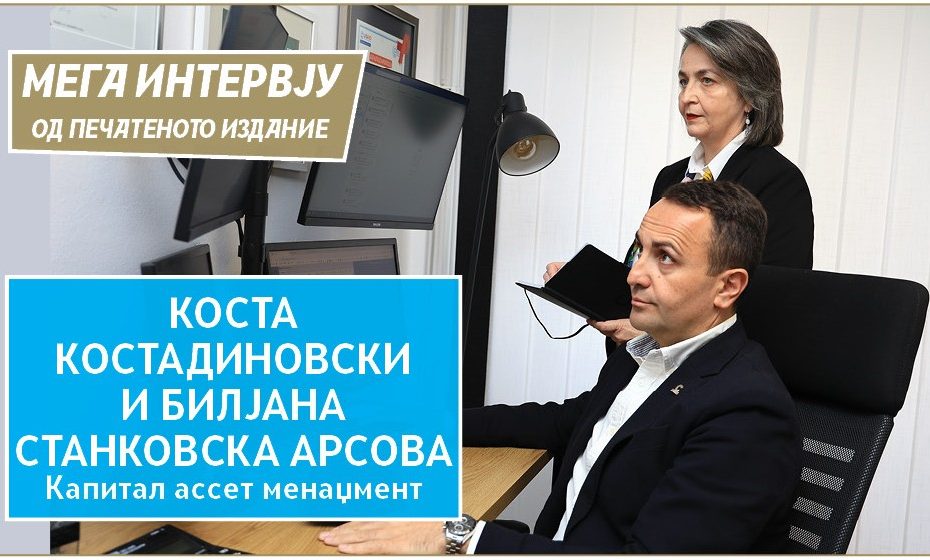
The global economy is under great pressure from geopolitics. Inflation persists at a higher level than desired, developed economies achieve relatively low growth rates, and uncertainty about customs policies. How do all these circumstances reflect the sentiment and behavior of existing and potential investors in stock exchanges?
Kostadinovsky: The uncertainty of the stock markets is a constant. Currently, the main topics are geopolitics, inflation, tariffs, and relatively low economic growth. However, stock markets are extremely stable given these circumstances. When it comes to inflation, it has a positive impact on the stock market, and it’s unfavorable for deposits and bonds. In terms of global economic growth, although the generally developed world faces such parameters, there are nevertheless companies on the stock exchanges that are growing more dynamically in their revenues and profits. There are also areas, such as our wider region within Europe, that are growing more dynamically than the more developed part of the continent.
Customs policies initially sent a shock to markets in early April, but markets are currently showing resistance to the issue. Stock prices have generally been on the upward slope since then. Given the relatively high inflation, which is still present to some extent, followed by generally high liquidity of economies, conditions have been created for more potential and existing investors to turn to stock markets, i.e. to invest more free cash in stocks.
How do you assess the movements of stock exchanges in our region, including the Macedonian Stock Exchange?
Kostadinovski: As I said, the region is showing good economic results and has optimistic forecasts for the future. This is reflected in almost all stock exchanges. The Macedonian Stock Exchange made such a move last year, while other stock exchanges give higher yields year-on-year. The Ljubljana Stock Exchange is a record holder in the region and in Europe. The share prices of most of the Macedonian companies on the stock exchange, according to our analysis, are higher in terms of objective valuations.
A very important element for the development of financial markets is the level of financial education of economic entities. Unlike previous generations who were not sufficiently informed and educated about investing in financial instruments, it seems that the generally new generation, the so-called son-in-law, is much ahead in acquiring financial literacy. Are there any preconditions for dynamizing stock market activities for this reason?
Stankovska Arsova: A new generation of investors, especially the son-in-law generation, is starting to invest earlier than ever. According to international research, the average age at which Gen Z starts investing is only 19 years old, compared to 25 years for millennials or over 30 years old for Generation X and baby boomers. Compared to older generations, the son-in-law generation has a different approach to financial information. Instead of seeking advice from banks or institutions, they increasingly rely on information available on social media, friends and family. Digitization plays a key role because as many as 65% of young investors use mobile apps and digital platforms. They usually start with small amounts of so-called micro-investments that they gradually increase over time. Here you need to be careful about the risks because a large number of young people focus on speculative instruments that offer astronomical returns – cryptocurrencies, forex and derivatives (options, futures, stocks with credit). It is for these reasons that stock market trading is dynamised by emphasizing that it is crucial that this generation is properly targeted, educated, and leveraged by the experiences of previous generations.
Let’s turn now to Capital Asset Management. First, you position yourself as an independent investment advisor. What does independence mean and why is it important to the users of your services?
Stankovska-Arsova: Capital Asset Management has been operating for five years and is still the only specialized and independent investment advisory and securities portfolio management company. The independence of the company, together with the part of the regulation dedicated to protecting the interests of the client, is a unique combination that puts the client first.
The majority of our clients are clients who have never had experience investing in stocks before, but have free cash to invest. We educate them, acquaint them with the benefits of investing in stocks, help them understand what the essence of equity is, and that, by investing in stocks in the right way, they can create real and genuine property that provides passive income from dividends and capital gains. By having such capital that generates passive income, you are freer to make decisions – whether for your career or for your personal life. This is the essence of independence.
Where to invest in these times of general uncertainty? Many say that in such uncertain times it is more important to “park” assets in safe forms of investment than in uncertain large returns. In this context, globally, the price of gold is reaching record levels.
Kostadinovski: Uncertainties in the markets have existed and will continue to exist. Therefore, it is important to use mechanisms to manage those risks in order to obtain excellent results. For example, when buying shares, we are mindful of the level of indebtedness of firms, which proved extremely important in the Covid crisis when certain business sectors stalled significantly – such as hospitality and hospitality. In this sector, non-indebted or low-indebted companies have emerged as winners of the crisis, whose shares are trading at several times higher prices in the markets today.
In businesses where there is fiercer competition, it is especially important to monitor the margins of the companies from which we use data on the company’s competitiveness. For example, in the pharmaceutical sector, there are companies operating at 10, 20 and 30 percent net margins, and this makes a big difference in the competitiveness and profitability of companies. That is why our analysis and the processing of the analyses of the world’s major investment banks, which are done by our team of analysts, is crucial.
Gold, in this context of inflation and pronounced geopolitical tensions, has reached record levels and is likely to hold higher levels for longer. Uncertainty is a unique constant in capital markets, but there is always one big certainty – that good companies will generate revenue, make profits, pay dividends, and grow in business. Therefore, investing in stocks with professional guidance in the long run results in beating inflation and further increases the value of the invested assets.
The demand for cryptocurrencies is also constantly growing. How do you see them as an investment opportunity? Warren Buffett, for example, doesn’t like them very much, but the impression is that the development of appropriate regulation for their trading is intensifying and their inclusion in the portfolios of the major “players” in the market is increasing.
Kostadinovsky: First of all, from the point of view of our regulation, according to our operating licenses, we are not allowed to invest in cryptocurrencies, which, in my opinion, is correct. Cryptocurrencies are not a property that investors should have in a large percentage of their portfolio. There are many ambiguities in determining the real value of cryptocurrencies and cannot be evaluated against any standard economic metric. Only supply, demand, and the belief that someone else will pay a higher price for that cryptocurrency are the forces that drive that market.
On the other hand, it is certain that the technology behind cryptocurrencies will enter everyday life and have its own application and value, but it cannot currently be correlated with cryptocurrency prices in any way.
What is it that sets Capital Asset Management apart from your competitors?
Stankovska Arsova: The market is saturated with a sufficient number of brokerage services both domestically and from foreign platforms. However, more than 95% of the people in the country need quality investment advice and professional management, not just the availability of good infrastructure. Equity investing is an investment in real estate that requires proper market experience, knowledge of analysis and proper guidance from authorized investment advisors. Our task is to monitor the market and the results of the companies with the intention of selecting the most suitable companies in which to invest our clients’ money. Our service – individual securities portfolio management – is designed for investors who want to put their money on the stock exchange, be part of large regional and global companies and thus beat inflation and make a profit, but do not have enough time or knowledge to constantly monitor and analyze companies. Through our service, the client acquires shares from domestic, regional or global companies that are in their name, although the choice is left to our experts, portfolio managers who monitor companies and markets on a daily basis. The uniqueness of our operations is that our overall focus is on finding quality investment solutions.
What is the difference between a broker and an investment advisor?
Stankovska-Arsova: Usually the public associates investing on the stock exchange only with the profession of a broker and from this association arise the greatest risks, i.e. citizens reluctant to start trading on the stock exchanges on their own, often listening to advice from brokers or even worse from influencers. A broker’s job is to execute orders from the client, not to advise them. That is why the regulator clearly delineates the powers of a broker and an investment adviser.
The broker has an interest in trading more frequently because the income is generated by executing a buy-sell transaction or a popular cash roll. The role of an investment advisor, i.e. portfolio manager, is to buy and sell stocks on behalf of and on behalf of their clients based on facts and company analysis. Its income is directly dependent on the volume of assets under management and on the net profit it makes for the client.
Logically, the question of security is now being raised. How are you organized?
Kostadinovsky: The Securities Act also regulates the security of deposits. It is secured so that the funds are deposited into a special dedicated client account that is set aside from the Company’s property. And the purchased securities are held in an authorized depository or depository institution. That is, when the client pays money and shares are used to buy shares, those shares are owned by the client himself, i.e. the company has the role of asset manager, the ultimate owner of which is the client.
The entire system from signing a contract with the client (which is unified and obtaining a work permit is approved by the regulator) to the payment of funds and keeping the securities with an authorized depository is fully legally covered, i.e. systemically secure. That is, if a client has 100 shares of a company registered in the Depository, they are as secure to him as his 100 square feet of flat which he has on the Cadastre Property List.
To conclude the interview, for someone who is not currently an active investor and has savings, how do you encourage them to start investing? How can Capital Asset Management help turn that initial amount into long-term financial stability?
Stankovska Arsova: Any investor who wants to invest in the stock exchange, without any experience, it is best to choose a professional, licensed investment advisor who will show him the way and the right approach to investing and how to be a winner in the market in the long run.
In our experience so far, the clients with the most success are clients who have taken the first step into investing, using our service with an individual approach and who increase their investment continuity, especially in situations where there are extraordinary opportunities in the markets that we take care to report to them in a timely manner.
In this way, practically, we significantly reduce the risk or possibility of inappropriate timing of entry, while at the same time using our many years of experience to identify the right opportunities at the right time and thereby obtain an above-average profit. Clients who follow our recommendations, continuously, without exception have excellent results.